
Choosing the right business structure is the single most important legal decision you will make when entering the Thai market. For foreign investors, the default "Thai Limited Company" often feels restrictive due to the 49% foreign ownership cap. Fortunately, there are powerful alternatives that allow for 100% foreign control.
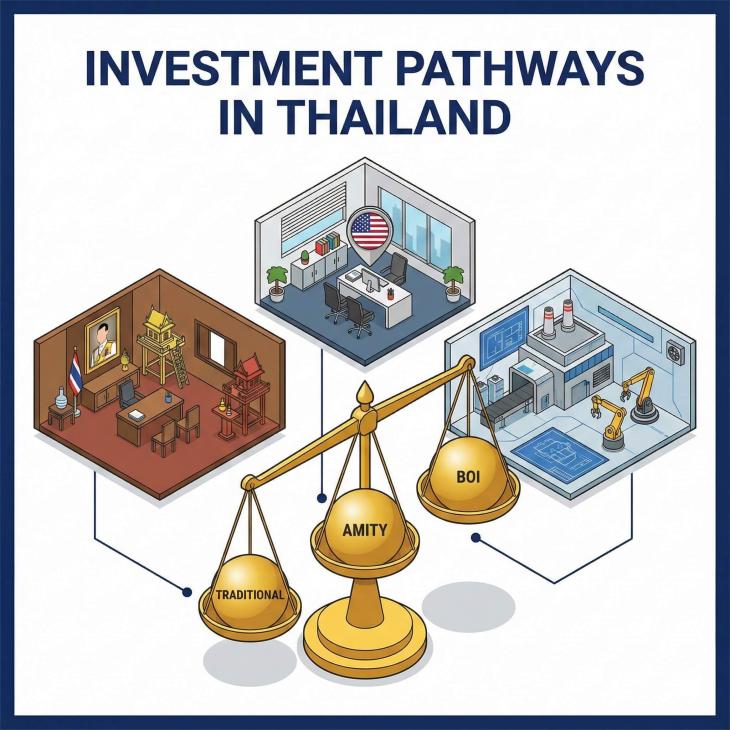
At PS Law & Business, we frequently guide clients through this decision matrix. This guide compares the three most common paths: the Standard Thai Company, the US Treaty of Amity, and the Board of Investment (BOI) Promotion.
The Three Contenders
1. Standard Thai Limited Company
This is the most common business structure in Thailand. It is flexible and quick to set up but comes with a major caveat for foreigners: under the Foreign Business Act, you generally cannot own more than 49% of the shares. The remaining 51% must be held by Thai nationals.
2. US Treaty of Amity
Exclusive to American citizens and American-owned corporations, this treaty grants "National Treatment." It allows US investors to own 100% of the company without needing a Thai partner, although certain sectors (like land ownership and communications) remain restricted.
3. Board of Investment (BOI) Promotion
The BOI is a government agency that incentivizes specific industries (like tech, manufacturing, and export) which are beneficial to Thailand's economy. If your business qualifies, you can be granted 100% foreign ownership (regardless of your nationality), along with significant tax and visa benefits.
Comparison Table: At a Glance
| Feature | Standard Thai Company | US Treaty of Amity | BOI Promotion |
|---|---|---|---|
| Foreign Ownership | Max 49% (usually) | 100% (US Citizens only) | 100% (Any Nationality) |
| Tax Incentives | None (20% Corp Tax) | None (20% Corp Tax) | Tax Holidays (0% for 3-8 years depending on category) |
| Land Ownership | Yes (if Thai majority) | No | Yes (For office/factory/residence) |
| Min. Capital | 2 Million THB (per work permit) | 2-3 Million THB (depending on FBA list) | 1 Million THB (investment only) |
| Work Permit Ratio | 4 Thais : 1 Foreigner | 4 Thais : 1 Foreigner (usually) | Relaxed (Often waived via One Stop Service) |
| Setup Time | 1-2 Weeks | 6-8 Weeks | 3-6 Months |
Which Structure is Right for You?
Choose the Standard Thai Company if:
- You are opening a small business (bar, restaurant, local shop) that does not qualify for BOI.
- You have a trusted Thai partner or spouse who will genuinely co-invest with you.
- You need to get the business running immediately (fastest registration time).
Choose the US Treaty of Amity if:
- You are an American citizen or an American-owned entity.
- You want absolute 100% control of your shares and voting rights.
- Your business activity is a service (e.g., digital marketing, consulting, agency) that typically isn't eligible for BOI promotion.
- You do not need to own land.
Choose BOI Promotion if:
- You are in a "Target Industry" (Software, Tech, Manufacturing, Bio-tech, etc.).
- You are NOT American (or you are American but want tax breaks).
- You want to avoid the strict "4 Thai employees per foreigner" quota (BOI companies have access to the "One Stop Service" center for easier visas).
- You plan to buy land for your factory or office.
FAQ: Choosing Your Structure
1. Can I switch from a Thai Company to a Treaty or BOI company later?
Yes. Many businesses start as a Standard Thai Company to get up and running quickly. Once operations stabilize, they can apply for Amity Treaty certification (if American) or BOI promotion. However, restructuring shareholding later can be complex, so it is better to plan ahead.
2. Is the "Nominee" structure legal?
No. Using "nominee" shareholders (Thai nationals who hold shares on your behalf but have no actual investment or control) to bypass the 49% limit is illegal. The government actively investigates such structures. The Treaty of Amity and BOI are the legal, transparent alternatives to this risk.
3. Can a Treaty of Amity company get BOI privileges?
Yes, an American company can be registered under the Treaty and apply for BOI incentives. This is the "gold standard" for US investors in tech or manufacturing, as it combines the rights of the Treaty with the tax breaks of the BOI.
Further Reading
- Thailand Board of Investment (Official Site) – Search for eligible business categories for promotion.
- US Commercial Service Thailand – Official details on the Treaty of Amity application process.